

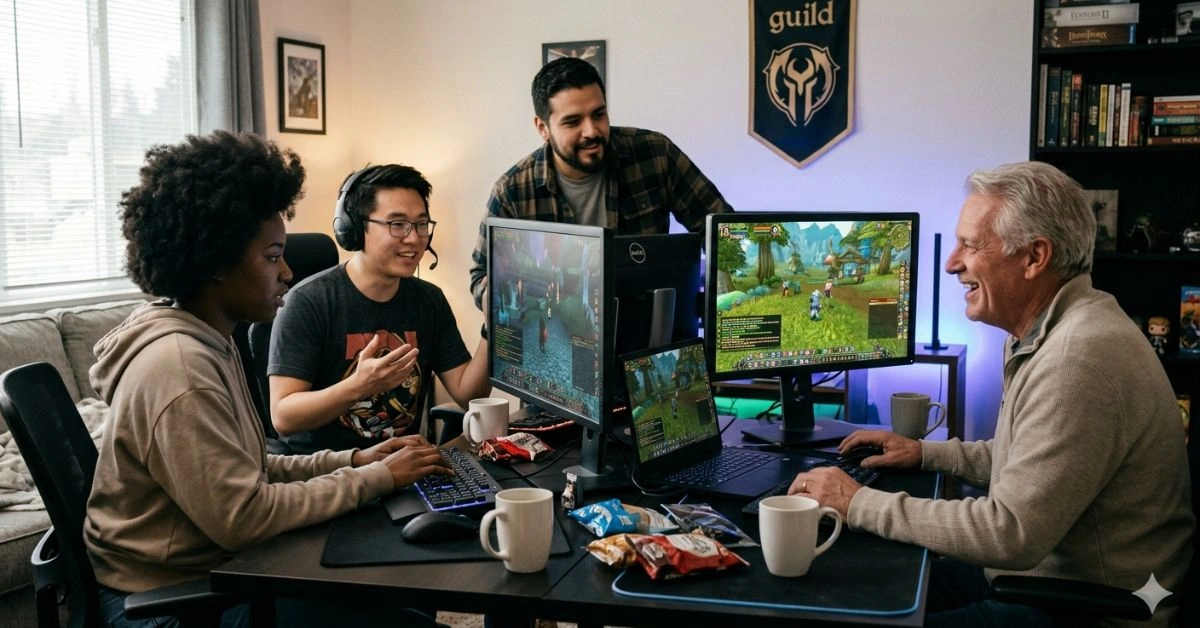

If you’ve spent any time around gaming communities, you’ve probably heard the term “MMO” tossed around a lot. People talk about spending hours on them, making friends through them, or even losing sleep over them. But if you’ve never actually played one, the whole concept might still feel a little fuzzy.
So let’s clear that up.
Understanding what is massively multiplayer online games is not as complicated as it sounds. At their core, these are video games where a huge number of players — sometimes in the millions — all exist in the same online world at the same time. They chat, trade, fight, build, and explore together, often for years on end.
This article breaks down everything: what these games are, how they work, why people get so into them, and what kinds exist. Whether you’re a curious newcomer or someone who wants a deeper understanding of the genre, you’ll find what you’re looking for here.
What Does Massively Multiplayer Online Actually Mean
Let’s start with the phrase itself, because it’s actually pretty descriptive once you break it down.
- Massively — not just a few players, but potentially hundreds of thousands of people logged in simultaneously.
- Multiplayer — you’re playing alongside real people, not computer-controlled bots.
- Online — the game lives on internet servers, not on your local machine. The world exists even when you’re offline.
Put all three together, and you get a game world that’s enormous, populated by real humans, and always running. That’s the backbone of every MMO ever made.
What separates these games from your typical online shooter or sports game is persistence. In most online games, when the match ends, the world disappears. In an MMO, the world keeps going. Your character stays where you left them. Markets shift overnight. Guilds plan attacks while you’re sleeping. The game doesn’t wait for you — and that’s part of what makes it so addictive.
A Short History of MMOs
MMOs didn’t just appear out of nowhere. They grew slowly over decades, shaped by changing technology and player expectations.

The Early Text Days
Before graphics were even part of the picture, people were playing online together through text-based games called MUDs — Multi-User Dungeons. These ran on university networks in the late 1970s and 1980s. You’d type commands like “go north” or “attack goblin” and read descriptions of what happened. Primitive, yes — but the concept of a shared, persistent world was already there.
The First Graphical MMOs
The 1990s brought the internet into homes and, with it, the first graphical MMOs. Ultima Online launched in 1997 and gave players a top-down world to explore together. EverQuest followed in 1999 with 3D graphics and deeper gameplay. These titles had modest player counts by modern standards, but they proved the model worked.
When MMOs Went Mainstream
Everything changed in November 2004 when Blizzard released World of Warcraft. Within a year, it had millions of subscribers. At its peak, over 12 million people were paying a monthly fee to play it. WoW turned MMOs from a niche hobby into a global phenomenon and set the template that most games in the genre still follow today.
Where Things Stand Now
Today, the genre is massive and varied. Free-to-play models have replaced many subscription fees. Mobile has opened MMOs to entirely new audiences. Games like Final Fantasy XIV, Elder Scrolls Online, and Black Desert Online attract millions of players and release regular content updates. The genre isn’t slowing down — it’s expanding into new formats every year
How Do MMOs Actually Work
If you’ve never played one, you might wonder what people are actually doing in these games. Here’s a straightforward breakdown.
Creating a Character
When you first log into an MMO, you create a character. This usually means choosing a race (human, elf, orc, etc.), a class (warrior, mage, healer, etc.), and customizing how your character looks. Some games offer incredible depth here — you can spend an hour just adjusting facial features.
Entering the World
Once your character is created, you enter the game world. Most MMOs have a tutorial area where you learn the basics — how to move, fight, talk to NPCs, and pick up quests.
Quests and Progression
Quests are tasks you complete to earn experience points, which level up your character. As you level up, your character gets stronger, unlocks new abilities, and can access more of the game world. This progression loop — do quests, get stronger, tackle harder content — is the core of most MMO gameplay.
Grouping With Others
Solo play is possible in most MMOs, but the genre truly shines when you play with others. You might join a group to clear a dungeon, raid a castle with 20 to 40 other players, or compete in player-versus-player combat zones. These shared experiences are often what players remember most.
The Social Layer
Beyond gameplay, MMOs have guild systems, in-game chat, player markets, and sometimes even player-run governments. In EVE Online, for example, players run entire corporations, stage political coups, and conduct wars that are covered by real news outlets. The social dimension of MMOs is not a side feature — it’s often the main attraction.
The Different Types of MMOs
Not every MMO is a fantasy RPG with elves and dragons. The genre covers a lot of ground.
MMORPG — The Most Common Type
Massively Multiplayer Online Role-Playing Games are what most people picture when they think of MMOs. Players take on a character role, follow storylines, and develop their characters over time. World of Warcraft, Final Fantasy XIV, and RuneScape are all MMORPGs.
MMOFPS — Action-Focused MMOs
These combine the large player counts of MMOs with the fast gameplay of first-person shooters. PlanetSide 2 is the best example — massive battles involving thousands of players fighting over territory on a single planet-sized map.
Sandbox MMOs
Sandbox MMOs give players the freedom to define their own goals. There are no scripted story paths — you choose whether to become a trader, a pirate, a crafter, or a warlord. EVE Online and Albion Online are popular examples. These games can feel overwhelming at first but offer almost limitless depth.
Mobile MMOs
The smartphone era brought MMOs to people who would never sit at a gaming PC. Games like Ragnarok M: Eternal Love and Black Desert Mobile offer full MMO experiences on phones. Mobile MMOs tend to be more accessible, though they often rely more heavily on microtransactions.
MMO Battle Royale and Survival Games
Some modern games blur genre lines entirely. Survival games with massive shared servers share the persistent world and social elements of traditional MMOs while mixing in crafting and survival mechanics.
Why Do People Play MMOs for Years
This is the question non-gamers often ask. Why would someone spend hundreds or even thousands of hours in a single game?
The honest answer is that a good MMO offers something most entertainment doesn’t: a sense of genuine progress, meaningful social connection, and a world that actually responds to you.
When you help a guild clear a difficult raid after weeks of trying, that victory feels real. When you spend months building up a character and finally reach the highest levels of endgame content, that satisfaction is earned. When you make friends in a game and play together for years, those relationships matter even if they started online.
There’s also the escapism factor. Life can be stressful and monotonous. Stepping into a world where you’re a hero on an adventure — even if it’s a digital one — gives people a mental break.
Some researchers have noted that MMOs satisfy several core human needs at once: belonging, competence, and autonomy. When a game hits all three, it’s hard to walk away from.
You can explore more expert tech content at Techslassh 2026: Your Guide to Tech, Reviews & Tutorials, where everything is explained in simple terms.
Downsides Worth Knowing About
It would be dishonest not to mention the drawbacks.
- Time commitment — MMOs are designed to be played for hundreds of hours.
- Toxicity — Large communities attract all kinds of people.
- Microtransactions — Many free-to-play MMOs make money through in-game purchases.
- Server shutdowns — When a game stops being profitable, its servers close.
Tips if You’re Thinking About Trying an MMO
If this article has made you curious, here are a few practical starting points.
Start free. Several top-tier MMOs offer generous free trials.
Don’t rush. The journey matters more than the destination.
Find a community. Join a beginner-friendly guild early on.
Pick a game that fits your schedule.
Frequently Asked Questions
Q1. What is massively multiplayer online games in simple terms?
An MMO is a video game where thousands of real players share the same online world at the same time.
Q2. Are MMOs free to play?
Many are free, while others use subscriptions or one-time purchases.
Q3. Can you play MMOs solo?
Yes, but group content is where they shine most.
Q4. Are MMOs good for kids?
It depends on the game and its content rating.
Q5. What is the most popular MMO right now?
Popular titles include World of Warcraft, Final Fantasy XIV, and RuneScape.
Q6. Do you need a powerful computer to play MMOs?
Not always — many run on low-end systems.
Q7. What is the difference between an MMO and a regular online game?
MMOs have massive scale and persistent worlds.
Q8. Is it too late to start playing older MMOs?
No, many older MMOs still have active communities.
Final Thoughts
MMOs are one of gaming’s most ambitious and enduring ideas. The concept of thousands of people sharing a living, breathing world — building friendships, writing stories together, and spending years invested in a shared experience — is genuinely remarkable.
Understanding what is massively multiplayer online games is really just the beginning. The best way to get the full picture is to pick a title, create a character, and start exploring.