





If you’ve ever worked with optical systems, you’ve probably seen the term what is ft-qpsi in verifire zygo mx software and thought, “This looks complicated.”
You’re not alone.
The name sounds technical, but the concept is actually easier than it seems once you break it down step by step. This guide explains everything in plain, human language—no confusing jargon.
Quick Fix
FT-QPSI (Fourier Transform Quantitative Phase-Shifting Interferometry) is an advanced measurement method used in Verifire Zygo MX software to analyze optical surfaces with extremely high precision by combining phase-shifting techniques and Fourier transform analysis.
👉 In simple terms:
It helps measure tiny surface details using light patterns—fast, accurate, and reliable.
Understanding Verifire Zygo MX Software (Basics First)
Before diving into FT-QPSI, let’s understand the software.
Verifire Zygo MX is used in high-precision optical testing. It helps engineers and technicians measure surfaces like:
- Lenses
- Mirrors
- Optical components
What the Software Does
- Measures surface quality
- Detects microscopic defects
- Analyzes wavefront errors
- Ensures products meet strict industry standards
Inside this software, different measurement methods exist—and FT-QPSI is one of the most advanced.

Breaking Down FT-QPSI (Simple Explanation)
Let’s decode the term:
- FT = Fourier Transform
- QPSI = Quantitative Phase-Shifting Interferometry
Simple Meaning
FT-QPSI is a method that uses light interference and math to measure extremely small surface details.
👉 Think of it like this:
It takes complex light patterns and turns them into clear, accurate surface data.
Why FT-QPSI Matters in Optical Measurement
In optics, even the smallest error matters.
We’re talking about:
- Nanometer-level precision
- Ultra-smooth surfaces
- Tiny defects that affect performance
Why FT-QPSI Is Important
- Improves accuracy
- Reduces noise in measurements
- Speeds up analysis
- Produces reliable results
Without it, modern optical manufacturing would struggle to maintain quality.
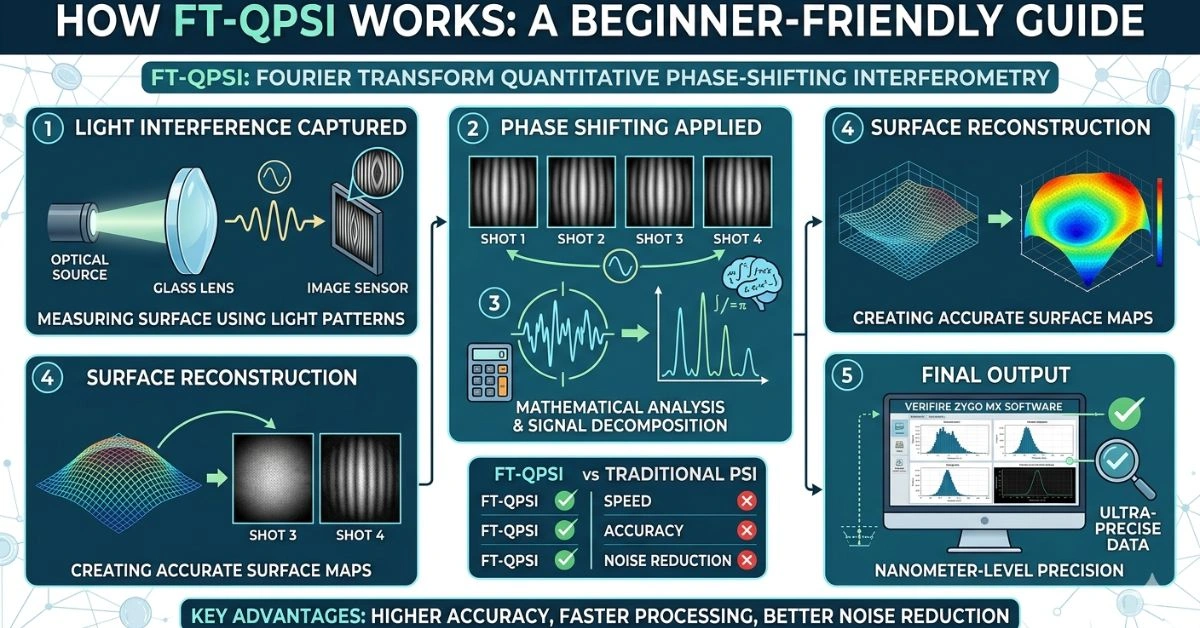
How FT-QPSI Works (Step-by-Step)
Here’s a simple breakdown:
1. Light Interference Captured
Light is projected onto a surface. The reflection creates an interference pattern.
2. Phase Shifting Applied
Multiple images are taken with slight shifts in phase.
3. Fourier Transform Processing
The system processes the signal using mathematical analysis.
4. Surface Reconstruction
Data is converted into a detailed surface map.
5. Final Output
You get accurate measurements of:
- Surface shape
- Irregularities
- Optical quality
FT-QPSI vs Traditional PSI (Easy Comparison)
| Feature | Traditional PSI | FT-QPSI |
| Speed | Slower | Faster |
| Accuracy | High | Very High |
| Noise Handling | Moderate | Excellent |
| Stability | Sensitive | More Stable |
| Data Processing | Basic | Advanced |
👉 Bottom line: FT-QPSI is a more advanced and efficient version of traditional PSI.
Key Advantages of FT-QPSI
1. Higher Accuracy
Captures even the smallest surface details.
2. Faster Processing
Fourier analysis speeds up calculations.
3. Better Noise Reduction
Filters unwanted signals effectively.
4. Improved Stability
Works well even in less-than-perfect conditions.
5. Industry Ready
Perfect for high-precision environments.
Where FT-QPSI Is Used
FT-QPSI is widely used in:
Optical Manufacturing
- Lenses
- Mirrors
- Laser components
Semiconductor Industry
- Wafer inspection
- Micro-surface analysis
Aerospace
- High-precision optics
- Imaging systems
Research Labs
- Experimental optics
- Material science
Real-World Example (Easy Understanding)
Imagine you’re making a high-end camera lens.
Even a tiny defect (invisible to the eye) can ruin image quality.
FT-QPSI helps you:
- Detect the defect
- Measure it precisely
- Fix it before production
👉 That’s why it’s so important.
Common Misunderstandings About FT-QPSI
❌ “It’s just another tool”
✔️ It’s actually a combination of advanced techniques.
❌ “Only experts can use it”
✔️ Modern software makes it easier to use.
❌ “It’s optional”
✔️ In high-precision industries, it’s essential.
Limitations of FT-QPSI
No system is perfect.
Challenges
- Requires proper calibration
- Needs a stable environment
- Can be complex for beginners
- Depends on software setup
👉 Good news: These are manageable with proper training.
Tips for Using FT-QPSI Effectively
1. Ensure Proper Setup
A stable environment improves accuracy.
2. Understand the Data
Don’t just trust results—analyze them.
3. Calibrate Regularly
Keeps measurements consistent.
4. Learn the Software
The more you explore, the easier it gets.
Future of FT-QPSI Technology
FT-QPSI is evolving fast.
What’s Coming Next
- Faster processing
- AI-based analysis
- Higher precision
- Easier interfaces
👉 This means it will become even more powerful and beginner-friendly.
Why Beginners Should Learn FT-QPSI
If you’re new to optical measurement, this concept is a big win.
Benefits
- Builds strong fundamentals
- Improves technical understanding
- Makes advanced tools easier to use
👉 Once you understand FT-QPSI, many other concepts become easier.
- If you’re exploring automation tools, don’t miss our guide on AI Tools to Create Study Notes Automatically: Complete Student Guide.
- Facing technical issues? Check PS Controller Not Working on PC Games Fix Guide (2026) for troubleshooting tips.
- Learn how updates impact systems in Why Updating ImmorPOS35.3 Software Is Important— Full Guide.
- Also read How to Fix Game Crash After Update (Easy Fixes) for additional tech insights.
FAQS
1. What is FT-QPSI in Verifire Zygo MX software?
FT-QPSI is an advanced measurement technique that uses phase-shifting interferometry and Fourier transform to analyze optical surfaces with high precision.
2. What does FT-QPSI stand for?
It stands for Fourier Transform Quantitative Phase-Shifting Interferometry.
3. Is FT-QPSI better than traditional PSI?
Yes, it offers better accuracy, faster processing, and improved noise handling.
4. Where is FT-QPSI used?
It is used in optical manufacturing, semiconductors, aerospace, and research labs.
5. Is FT-QPSI hard to learn?
It may seem complex at first, but with practice and simple explanations, it becomes easier.